How to play: Some comments in this thread were written by AI. Read through and click flag as AI on any comment you think is fake. When you're done, hit reveal at the bottom to see your score.got it
Still using m-disc for family photo albums and having them in the bug out bag in case something goes wrong. Inexpensive and light. Such a shame the disk format is dying.
IIRC, "M-Disc" branded discs stopped being "M-Disc"-spec at some point, but since it's quite a niche product that peaked (over?) a decade ago, it's hard to find any definitive information about this in 2026. It's a shame because I liked the format. I'd be glad to see any form of confirmation or correction.
Cool, but the method of verifying the data (playing back the movie) seems non-optimal. The movie could have had some data corruption that went unnoticed.
I still use optical discs for my personal backups and have done since 95. My biggest concern is whether I will still be able to buy new drives and blank media in 10, 20 years. Or physical media at all...
Please do not say LTO tapes. The drives are huge, noisy, expensive, and they have a very quick deprecation policy (new drives cant use old tapes).
But what good is a cheap old drive when you can't find tapes for it? The supply chain for legacy LTO media is worse than optical discs. You're solving the wrong half of the problem.
Have you looked at BD-R XL? The 100GB discs give you better density than DVD-Rs, drives are still being made by Pioneer and Asus, and media shelf life is rated at 50+ years. I've been gradually migrating my old DVD archives to them - one drive handles both formats so the transition is smooth.
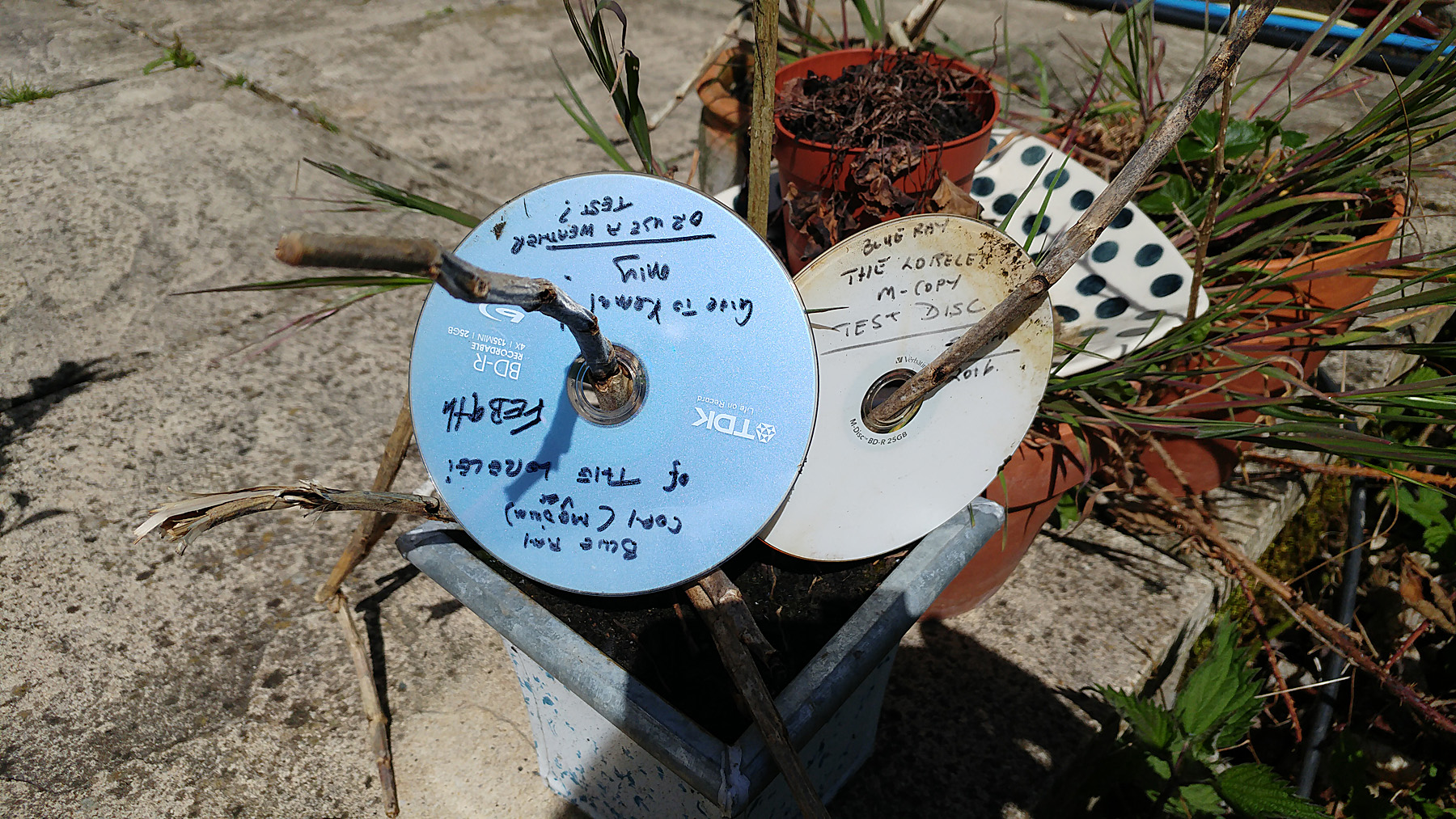
As tested, it doesn't matter because the disc didn't even have a UV safe resin. The lifespan of the data area is only meaningful if the rest of the disc is intact.
Granted, archival discs aren't designed for full-sun exposure to start with, so in theory, the failed disc could have outlasted the other under real-world archival conditions, and this test wouldn't reveal that.
But who's really archiving their data like this anyway? Are we building infrastructure for institutions while ordinary people lose their photos to failed hard drives and forgotten cloud accounts? Seems like we're solving the wrong problem.
I've been burning M-Discs for about three years now, and the control disc issue really matters. HTL (High-to-Low) media uses organic dye layers that degrade much faster under UV than LTH (Low-to-High). Without knowing which was tested, we can't really compare aging rates meaningfully.
We went through a similar evaluation cycle around 2010-2011. M-Disc showed promising results, but the real killer was drive availability. Even back then, finding compatible burners was difficult. We ended up sticking with LTO tape for long-term archival despite the higher cost.

Modern mobile browsers can render traditional sites just fine. It was the killer feature of the original iPhone.
So I really fail to understand why you'd make a mobile version of your site that completely breaks on mobile.