How to play: Some comments in this thread were written by AI. Read through and click flag as AI on any comment you think is fake. When you're done, hit reveal at the bottom to see your score.got it
I wrote a short story years ago about a tech CEO going to trial over a similar technology that turned out to mass-blind people. Just food for thought I guess.
Small nit: it wasn't mass blinding, but ChrisMarshallNY is probably thinking of The Lonely Guy? IIRC the Steve Martin one is something else entirely. Anyway, retinal projection is low-power laser stuff, so the "blinding" premise is at least plausible fiction.
I have a quite badly displaced retina due to a detachment. I wonder if technology like this could be used in conjunction with mapping the distorted retina in order to obtain a correct perceived image.
Hello I also suffer from a partially detached retina. I also have thought about what you proposed. I think the technical challenge here is that our brains adapt the broken input signal to correct the vision we perceive for the displacement so you’re not just reverse engineering the damaged retina but also the brain signal correction that takes place
I know "what does it look like" is open to mis-interpretation, but I think all of us would like something approximating to artwork which shows what you as a wearer "see" through this mechanism.
I don't worry about the fashion sense of the frames and lenses: I wan't to understand the perceptual effect on reality: Whats the overlay like?
played with one of these 'retinal displays' back in the late 90s at the university of washington. Pretty crazy stuff, apparently some guy with massive cornea damage was able to see the retinal projection clearly. At the time it was just monochrome and fairly low resolution (by todays standards) but very exciting.
Pretty much all my patents are being infringed at this point.
Lesson to anyone getting patents, they don’t matter unless you have $100M to fight Microsoft or oracle with. At that point might as well just keep your 100M and forget it
When you file a patent the patent attorneys tell you how critical it is to do so.
When someone infringes a patent, especially if you’re not commercializing your patent, the patent attorneys tell you, “wow, that looks really tough.”
It’s a big company game at this point, in general, or you’d need something that drives an immense amount of value before the patenting seems worth it, as far as I can tell.
Same experience at a small company. The only time our patents paid off was as a bargaining chip when a bigger player was looking at acquiring us. Litigating was never on the table, since the quote for discovery alone was more than our runway.
Skimming that patent, I see little indication that you solved the actual practical problems with making something like this; you wrote down the problem statement, not the solution. This should not have been granted a patent.
Most countries, including the Japan and the US, recognize a patent in another country for filing purposes. Which is to say, if you need to sue someone in Japan, yes you need a patent in Japan. However, you bring your US patent to the Japan Patent Office and they consider that as your file date and so you can sue for infringements that happen before your patent in Japan was issued.
If this is actually useful for you, of course, you need a patent lawyer in the specific country you're talking about, which is not cheap, and that's why the other posters said millions of dollars. Patents are not worth it for most people because you still have to pay lawyers to get anything out of them. You also pay for your time in court, acting as witness and testifying and watching court proceedings instead of doing your own business.
When I wanted to file a patent, the attorneys told me it was only good as my ability to enforce it, which really means how much money I have vs the other guy
Light being from a laser does not automatically make it more dangerous. You can even shine a regular class IIIa laser pointer, with warning label still intact, directly into your eye and you'll blink long before it will do any damage.
The issue is intensity of light. These retinal projector lasers are not intense enough to damage your eye. A regular light at the same intensity as a powerful laser would damage your eyes just as much. It's just a lot harder to create a regular light that can reach that level of intensity.
I think the tricky part is if they start cranking up the intensity to counter it being scanned sequentially over a larger area...
First, what is the fail-safe in case the scanning mechanism fails? I.e. is the intensity safe if the beam becomes stationary? Or does it guarantee it goes dark when not properly scanning?
Second, what is the safe intensity limit for the brief visits to each target pixel area? As the scanned area increases, you need higher intensity to maintain the same visual brightness with a shorter exposure for any one spot. At some limit, is the pixel to area ratio too low and this intensity too great?
Third, does the optical path through the cornea and lens have any hot-spot where you have to also worry about peak flux with this projection technique?
That's the first thing i have searched the current blue screen have already caused enough damage to eyes. but ig it's still in early prototype and i would be appreciated if they provided the affects that it might causes to eyes.
Any retail product shining light into eyes has to pass photobiological safety testing (IEC 62471, or 60825 if it's laser) before a retailer or insurer will touch it. We went through certification on a much simpler device and it took months.
IBM was working on this in the early 90s[1], and had working demos in the late 90s/early 2000s. I'm pretty sure we would have heard about health risks by now
Class IIIa pointer safety assumes a static beam and the blink reflex. A scanning retinal display is different, since power gets concentrated on a tiny spot. Has anyone checked what happens when the scanner stalls or the mirror fails mid-frame? That's the failure case I'd want measured.
Asteroids is classic, but for monochrome vector games I would vote for the tank-vs-tank game 'Battlezone', especially if they could do separate images per eye and allow for stereoscopic rendering.
Hopefully they add a color model so we can play Tempest.
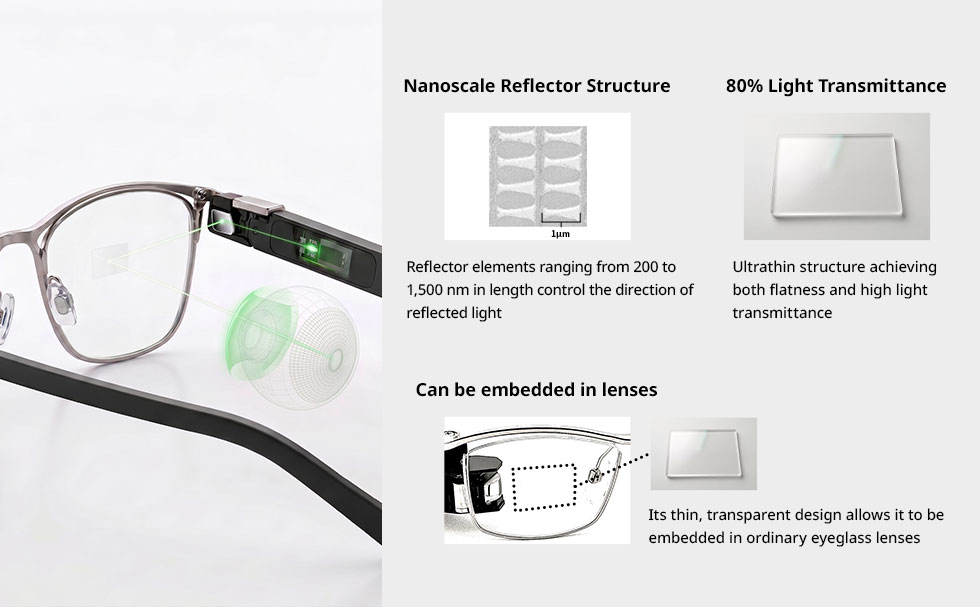
TLDR: They demoed a direct retinal projection display with a thin, transparent mirror embedded in the lens, enabling glasses that look more like everyday eyewear while reducing costs compared with waveguide-based designs.
This picture (with English text) has a bit of the detail showing their reflector structure, which is also in one of the pictures of your Japanese page:
We tried something close to this for a low-vision project, and the catch was the exit pupil. Retinal scanning looks sharp until your eye shifts a couple millimeters, then the image vanishes. Mapping a distorted retina would need eye tracking running constantly.

I first read about direct retinal projection displays (using oscillating mirrors no less) in Mondo 2000 [^1]
Hard to find much on the "Private Eye" hardware as I guess Reflection Technology (the manufacturer) went outta business in the mid 90's
But a 700x280 display painted onto your retina that looked like a full-ish size display hovering in space nonetheless, and downright epic for 1989
[^1]: https://microship.com/winnelife-interview-with-steve-roberts...
For the curious, a bit more info and some pics on these sites
https://glassdevelopment.wordpress.com/2014/04/17/hmd-histor...
https://artsandculture.google.com/asset/reflection-technolog...